Friday, 29 March 2013
Soundtrack
We have not featured a sound track.. deliberately. We chose to keep our sound deliberately diegetic. The only added noise was the static in the cut scenes. The foot steps at the start, over the top of the changing landscape shots - these were added from a previous shot filmed.
We feature no dialogue or sound track to increase the enigmatic atmosphere.

Tuesday, 26 March 2013
Thriller Evaluation: Question 6
Question 6. What have you learnt about technologies from the process of
constructing this product?
Websites and Blogging
Before starting Media, my only experience with any software used for film or sound editing would have been Windows MovieMaker in Year 8, to make an unofficial music video. The results were shameful. I had been used to blogging prior to blogspot however - years of Facebook, Twitter, and occasionally Tumblr provided experience. Blogspot seemed complicated at the start, but it's very similar to lots of other blog systems. I like how it almost serves as a forum for our media work; all of our work is uploaded to cnsmedia.blogspot.com and becomes almost an archive or library for us to review the work of other students, for inferences or almost a how-to-answer guide. It provides a more age-relevant approach to coursework. Most of our life is online nowadays, the majority of our day is spent using internet in someway. We are all connected and socially interacted in one way or another, and blogs seize this opportunity, transferring it into an easy, interactive way to write up coursework. It's easy to constantly improve our work, and there are different ways to involve other medias... use of YouTube allows the ability to embed and upload videos through HTML code scripting. I can upload presentations, I can upload pictures and display them on my blog. The two external media websites I used were www.prezi.com and www.scribd.com - two presentation sites. Scribd allows embedding of files, whilst Prezi creates a diverse and interactive interface to presentations.
Since the discovery of Prezi, it has made it's way into several of my other AS subjects.
For example, here's a screenprint of it in use.
Websites and Blogging
Before starting Media, my only experience with any software used for film or sound editing would have been Windows MovieMaker in Year 8, to make an unofficial music video. The results were shameful. I had been used to blogging prior to blogspot however - years of Facebook, Twitter, and occasionally Tumblr provided experience. Blogspot seemed complicated at the start, but it's very similar to lots of other blog systems. I like how it almost serves as a forum for our media work; all of our work is uploaded to cnsmedia.blogspot.com and becomes almost an archive or library for us to review the work of other students, for inferences or almost a how-to-answer guide. It provides a more age-relevant approach to coursework. Most of our life is online nowadays, the majority of our day is spent using internet in someway. We are all connected and socially interacted in one way or another, and blogs seize this opportunity, transferring it into an easy, interactive way to write up coursework. It's easy to constantly improve our work, and there are different ways to involve other medias... use of YouTube allows the ability to embed and upload videos through HTML code scripting. I can upload presentations, I can upload pictures and display them on my blog. The two external media websites I used were www.prezi.com and www.scribd.com - two presentation sites. Scribd allows embedding of files, whilst Prezi creates a diverse and interactive interface to presentations.
Since the discovery of Prezi, it has made it's way into several of my other AS subjects.
For example, here's a screenprint of it in use.

Prezi is so intriciate that within its presentation ability, it allows the addition of more media styles - video, text and pictures are all different opportunities for combination to enhance your work.
Also, its zooming system allows the presentation to flow in a focused way - it follows a path and moves around your work with you. This makes it far more simple and accessible.

I felt these two websites helped to enhance the presentation of some of my blog posts.
During the evaluation part of my thriller, I felt I could further extend my use of media by uploading a video I filmed on my webcam, vocally discussing and describing my thriller.
Another website (which we used for the title 'Evito' at the start of our Thriller and that I have used in depth for my own personal use) is dafont.com - a free font download site, which has served me very well. It provides a creative touch to the text.
Now, as an example of other medias, I've decided to describe technology used with. (Through www.issuu.com )
And a second form: Prezi!
Monday, 25 March 2013
Thriller Evaluation: Question 5
Question 5. How did you attract/address your audience?
I know it may sound cliche, but we attracted our audience, by being our audience. We featured all the things that we wished to see in a thriller. As we knew what we wanted to see, we knew how we could please similar minded audiences. To attract an audience, you need to acknowledge are known as 'Audience Pleasures'.
Five sub categories of Audience Pleasures are as follows:
Five sub categories of Audience Pleasures are as follows:
-Narrative
-Genre
-Style/Aesthetics
-Thematic Pleasures
-Representational Pleasures
-Genre
-Style/Aesthetics
-Thematic Pleasures
-Representational Pleasures
Narrative
Narrative has further categories:
-Hook
-Cliffhanger
-Resolution
-Enigma
-Climax.
The Hook is your first opportunity, to grasp the audience and entice them. The aim of the hook is to literally hook them in, so they are inclined to continue watching with their foremost interest. I believe are hook comes in the first instance that characters are involved - a title scene actually.
-Hook
-Cliffhanger
-Resolution
-Enigma
-Climax.
The Hook is your first opportunity, to grasp the audience and entice them. The aim of the hook is to literally hook them in, so they are inclined to continue watching with their foremost interest. I believe are hook comes in the first instance that characters are involved - a title scene actually.
The sound is purely diegetic - wind blowing through the trees. We first notice EVITO - the title scene, and Gerhard walking. Then we notice K. Not moving, he's just there. I firmly believe this is where we get our Hook. "Whoah, who is that?!"
He is well concealed, so at first glance you may not notice him, so this is where we feel the questions start. The mangled, curved, fallen trees around him all add to the mystery of this scene.
He is well concealed, so at first glance you may not notice him, so this is where we feel the questions start. The mangled, curved, fallen trees around him all add to the mystery of this scene.

Our thriller doesn't use all of these all of these Narrative features though. We believe Enigma is maintained all throughout the clip, our use of subtlety, illusion and deception strongly carries that throughout. However, we were very intent on featuring a cliff hanger. Everyone loves a cliff hanger.
The final 20 seconds of clip, with the frequent cutaways to the dark cave like scene is a deliberately disorientating one. It appears to be happening simultaneously, but we are unsure of which ones past, or which ones future. We added static noise to add to the disorientation of the scene, and we feel it works perfectly, it's a repulsive, invasive noise and adds to the enigma. However, the grand cliff hanger is K dropping his mask whilst standing over him staring - the final thing we see is this image.

We thought this dimly lit, perspective shot of the mask was perfect. The black side and the golden side to the mask, and Gerhard's motionless body just laying there. The perfect mystery, as we felt. We were definitely full of questions like 'what next?'
That, was our cliff hanger.
We have no resolution, as it's just an opening scene, and the climax would come later on in the film also.
Genre
We kept it very genre-specific. We knew the features that a good Thriller had to have; we'd seen many, many thrillers and found different techniques and methods that we particularly enjoyed.
For the creation of KK - the masked character, I looked into the stereotypical slasher/killer archetype in thriller and horror, and add more mystery to them. I have stated several times the influence behind them, but I shall add some videos to this blog post to show.
That, was our cliff hanger.
We have no resolution, as it's just an opening scene, and the climax would come later on in the film also.
Genre
We kept it very genre-specific. We knew the features that a good Thriller had to have; we'd seen many, many thrillers and found different techniques and methods that we particularly enjoyed.
For the creation of KK - the masked character, I looked into the stereotypical slasher/killer archetype in thriller and horror, and add more mystery to them. I have stated several times the influence behind them, but I shall add some videos to this blog post to show.
See 4:55
This is where the idea for the blank expressionless mask came from.
All though this is a very pixelated, this also proved influencial.
Even though it was a video game, we felt it had captivated elements of a thriller - elements we could familiarly use.
(skip to 0:28)
Representational Pleasures
Representational Pleasures are often derived from Archetype or stereotypes within characters. For example, good guy/bad guy are usual archetypes in thrillers. However, instead we opted for anti-hero and kept KK unknown - he can be considered a villain, we do not know either way.
The anti hero status given to Gerhard matches up with his stereotypical appearance. He could be considered as homeless, or a 'low-life'/undesirable character. He could be considered to be involved with drugs or crime. This kind of inference is what makes a good character, when the audience questions for themselves.
KK as a character is brilliant. He carries the mystery beautifully, as we know nothing about him whatsoever. We don't know if he's cunning, or super human. We don't know if he's good, or bad.
He's pleasing as a character, because the bad guy should never reveal anything too quickly.
Thematic Pleasures
Everyone likes a mask.
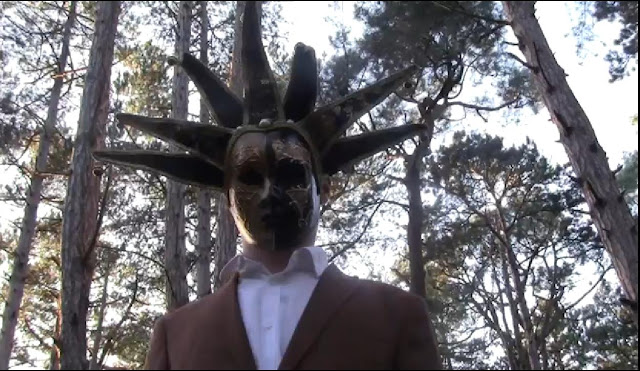
The blank, expressionless mask worn by Harvey (KK) here works perfectly. It shows no emotion, and especially, conceals his eyes. This is exactly how I envisaged him; he works perfectly and is moderately intimidating. The Venetian carnivale style clashes but matches the formal attire in an odd way, which in turn contrasts with the background and the surroundings of the forest. Costume and Location worked perfectly. (For KK. Gerhard's fake beard was the aspect that let us down. It was there for a small sense of humour, which I see in hindsight may not be accepted)

Friday, 22 March 2013
Thriller Evaluation: Question 3
Question 3: What kind of media institution might distribute your media product and why?
Tuesday, 19 March 2013
Monday, 18 March 2013
Monday, 11 March 2013
Thriller Evaluation: Question 7
Thriller Evaluation Question 7 - Looking back at your preliminary task, what do you feel you have learnt in the progression from it to the full product?
When beginning our preliminary tasks, I had no idea about conventions or techniques involved in film; this year has been my first introduction to Media. My preliminary task was poor, but I feel I have learnt and improved over the year - hopefully this reflects in the thriller.
I started Media late, and had only experienced a few weeks of lessons before beginning the Preliminary task - I only knew one person well, and was slowly getting closer with others, but didn't know them fully. We struggled to think of a concept and we neglected to write a script. Essentially, Ed and I improvised our entire preliminary task.
However, when approaching our full product we took more care in preparation - we created a detailed story line, and from an early start we had ideas for camera shots, locations and little features we could include in our thriller - to avoid the issue of struggling like we did in our Preliminary shot!
When deciding on ideas for our film, Evito, I took a more active role in the creative side - using influence from horror films and other thrillers. The story line took the most thought and creativity; the knowledge obtained through the evaluation and study of other thrillers - especially Film Noir crime films.
With the Preliminary task, we split up and edited in groups of two, with Evito, we remained as the group and gave feedback and continued to use our collective ideas to enhance the project - our input as a group helped make sure that the final product met our individual approval and featured the best ideas from all of us, which were debated and criticised with a group mentality.
Conclusively, the final product, Evito is a huge step forward from the Preliminary task - I learnt from the prelim task that I would need to approach the final task very differently - far more planning and interaction went into the process of creating the Thriller, to ensure that I wasn't caught short when it came to producing the film.
When beginning our preliminary tasks, I had no idea about conventions or techniques involved in film; this year has been my first introduction to Media. My preliminary task was poor, but I feel I have learnt and improved over the year - hopefully this reflects in the thriller.
I started Media late, and had only experienced a few weeks of lessons before beginning the Preliminary task - I only knew one person well, and was slowly getting closer with others, but didn't know them fully. We struggled to think of a concept and we neglected to write a script. Essentially, Ed and I improvised our entire preliminary task.
However, when approaching our full product we took more care in preparation - we created a detailed story line, and from an early start we had ideas for camera shots, locations and little features we could include in our thriller - to avoid the issue of struggling like we did in our Preliminary shot!
When deciding on ideas for our film, Evito, I took a more active role in the creative side - using influence from horror films and other thrillers. The story line took the most thought and creativity; the knowledge obtained through the evaluation and study of other thrillers - especially Film Noir crime films.
With the Preliminary task, we split up and edited in groups of two, with Evito, we remained as the group and gave feedback and continued to use our collective ideas to enhance the project - our input as a group helped make sure that the final product met our individual approval and featured the best ideas from all of us, which were debated and criticised with a group mentality.
Conclusively, the final product, Evito is a huge step forward from the Preliminary task - I learnt from the prelim task that I would need to approach the final task very differently - far more planning and interaction went into the process of creating the Thriller, to ensure that I wasn't caught short when it came to producing the film.
Sunday, 10 March 2013
Thriller Evaluation: Question 1
Thriller Evaluation: Question1 - In what ways does your media product use, develop or challenge forms and conventions of real media products?
The opening of my thriller, Evito, is a horror influenced thriller which incorporates influences of classic, generic horror and an infusion of traditional thriller aspects. The main way this is built is up, is through the use of mise en scene and the idea of an enigma.
The title itself 'Evito' is a mystery - a vague latin word meaning to murder, escape, avoid or elude; Evito, as a word is appropriate for our thriller.
The story line is kept very unknown in the opening sequence. Unsurprisingly, the story themes are relative to the title - it follows G. Mattieu, a dirty, down-and-out lowlife of society into a his troubles. He is a dark character with a darker background and past. However, we are not the only one following him, and unfortunately for Mattieu, he is going to encounter difficult circumstance, for reasons as of yet unknown.
Many thrillers use the title to establish, or suggest towards a dilemma or theme within the film itself. An example being Se7en, a crime fiction film involving the Seven Deadly Sins idea, which he uses on his victims.
An influential film for Evito was The Strangers. A film which the killers, or villains in the film use illusion, subtly, shock, mystery and psychological torment to abuse the protagonists. It could be viewed as a Cat and Mouse hunting tactic.

The primary (one of two) locations for the film is a forest. Simple - the forest we used is a very spacious and unconventional forest. The trees are twisted and bizarre, perfect for the tone of the film. It is located in Wells, Norfolk. Forests are perfect for thrillers as they are empty, expressionless and emotionless. There is never telling what dwells within a forest, and due to it's obscured openness, you can never see what's hiding; perfect for Evito. The inference here is that G. Mattieu is both lost, and trapped.


The killer, who's name is forever unknown to the audience (but to us for affectionate reference named Karamel Kanu, so therefore K) was a simpler character to design. K says nothing and does not move, so the need to dress him up was a little less relevant. For this reason, K is wearing a suit shirt, jacket and trousers, adding to the unknown background of the character. His mask is a Venetian carnivale mask, it's gold and black design and emotionless features ensured that it was perfect and appropriate for the appearance of K.

Masks are frequently used in thrillers; the expressionless masks work best. For example, all of the characters in The Strangers wore masks - many of the most famous and reputable horror/thriller films have involved masks - SAW, Friday 13th, Nightmare on Elm Street, Halloween etc.

The opening of my thriller, Evito, is a horror influenced thriller which incorporates influences of classic, generic horror and an infusion of traditional thriller aspects. The main way this is built is up, is through the use of mise en scene and the idea of an enigma.
The title itself 'Evito' is a mystery - a vague latin word meaning to murder, escape, avoid or elude; Evito, as a word is appropriate for our thriller.
The story line is kept very unknown in the opening sequence. Unsurprisingly, the story themes are relative to the title - it follows G. Mattieu, a dirty, down-and-out lowlife of society into a his troubles. He is a dark character with a darker background and past. However, we are not the only one following him, and unfortunately for Mattieu, he is going to encounter difficult circumstance, for reasons as of yet unknown.
Many thrillers use the title to establish, or suggest towards a dilemma or theme within the film itself. An example being Se7en, a crime fiction film involving the Seven Deadly Sins idea, which he uses on his victims.
An influential film for Evito was The Strangers. A film which the killers, or villains in the film use illusion, subtly, shock, mystery and psychological torment to abuse the protagonists. It could be viewed as a Cat and Mouse hunting tactic.

I believe the idea of the killer in Evito works so well, is because the killer never takes an active role. In most shots, he is hiding in the background. The idea of enigma is very much established in his random presence in parts of scenes, and the anonymity of the character - for the entirety of the clip, we never see his face. He hides behind an expressionless Venetian mask, and remains out of focus in shots.

This is contradictory to the usual Slasher Thrillers, as the killer is usually given more attention. This way, the idea of a slow, impending sense of doom or finality is given as he is forever getting closer, but never making contact or seeming to move, thus giving him a superior, omnipresent or omnipowerful persona.
The primary (one of two) locations for the film is a forest. Simple - the forest we used is a very spacious and unconventional forest. The trees are twisted and bizarre, perfect for the tone of the film. It is located in Wells, Norfolk. Forests are perfect for thrillers as they are empty, expressionless and emotionless. There is never telling what dwells within a forest, and due to it's obscured openness, you can never see what's hiding; perfect for Evito. The inference here is that G. Mattieu is both lost, and trapped.

The second location is a section of our school, that closely resembled some kind of cell. It was dirty, enclosed and dimly lit, and frequently returned to throughout the film. It's a very undesirable place to be, and represents entrapment, finality and danger

With reference to Mise en Scene, it's important to get costume as best as you can. With G. Mattieu, we wanted him to look as filthy and undesirable as possible. (The only letdown being the fake beard) His appalling motto on the back of his jumper was a device to ensure that viewers do not think highly of him as a person, but his whole image and circumstances are designed so they feel sympathetic towards him too. His attire therefore matches his character. The facial hair, tracker hat, old hoody and track suit bottoms are referential to the archetype of a homeless man, or somebody with little money that is frequent to sleeping rough; the dirty, unkempt and uncaring appearance is somewhat typical.
The killer, who's name is forever unknown to the audience (but to us for affectionate reference named Karamel Kanu, so therefore K) was a simpler character to design. K says nothing and does not move, so the need to dress him up was a little less relevant. For this reason, K is wearing a suit shirt, jacket and trousers, adding to the unknown background of the character. His mask is a Venetian carnivale mask, it's gold and black design and emotionless features ensured that it was perfect and appropriate for the appearance of K.
Masks are frequently used in thrillers; the expressionless masks work best. For example, all of the characters in The Strangers wore masks - many of the most famous and reputable horror/thriller films have involved masks - SAW, Friday 13th, Nightmare on Elm Street, Halloween etc.

Evito breaks most conventions of Thriller, in that it has no dialogue. It is a completely speechless film; the noises heard are merely diegetic and non diegetic sounds that we felt were appropriate. The only sounds being: looming foot steps, wind blowing through the trees, noises involved in walking, static and noise from mask dropping. The lack of noise enhances the sense of enigma, as nothing is in place to explain the flow or the context to the story, the only sense truly explaining is vision, and the visual elements were most important.
Lighting is kept purely natural, no lighting was added, and no enhancing of light took place in production.
Conclusively, Evito features forms and conventions that the audience would understand; the suspense theme taken from Hitchcock - a pioneer of suspense, the horror element (along with thriller style of villian)taken from The Strangers. The locations are generic, and typical to Thriller films - blank and repetitive scenes and the use of forest allow the sense of emptiness, entrapment, emotionless and isolation mentioned previously.
Thursday, 28 February 2013
Final Cut of Thriller Opening
This is our final cut of our Thriller opening.
As a whole, we are all very pleased with our Thriller.
There are a few things we were unhappy about when reviewing it:
-How fake the beard looked in hindsight (humorous element)
-Acting quality (both of these irrelevant, as our focus was on the production and editing)
Other than that, we were very pleased with:
-The sense of enigma and mystery throughout the opening
-The eerie atmosphere surrounding the other character
-The audio worked perfectly - the static over the cutscenes.
Monday, 28 January 2013


Story board
Story board!
Post it notes used to explain the rough order of how our thriller would go; Vague idea and main ideas featured, rest of content to be decided when filming, as we would find out what was appropriate for our thriller on location, where we could alter and decide.

Post it notes used to explain the rough order of how our thriller would go; Vague idea and main ideas featured, rest of content to be decided when filming, as we would find out what was appropriate for our thriller on location, where we could alter and decide.

Tuesday, 8 January 2013
Tuesday, 18 December 2012
Monday, 17 December 2012
Treatment (Thriller plot line)
We fade into
a forest, illuminated by the cold mid-winter dawn.
A man is seen venturing through the woods. The leaves crunch beneath his feet, the snow gathers on his toes.
Twigs snap in the background; he thinks nothing of it.
Seconds pass, and he begins to dwell on the sound.
fearing a presence, he takes a brief look around, as if someone was there.
He reaches down to bury the contents of his pocket, wrapped in a small plastic bag.
In the background, a suited man wearing a venetian Carnivale mask appears, just watching.
He stands up again, looking around, clicking his neck. Unaware of anything else; the venetian masked man in the distance behind him.
he looks around, noticing the man.
He says nothing, and they maintain eye contact.
He promptly starts walking forward to leave the forest.
He looks back as he’s walking, the man closer than before, but standing perfectly still in the same stance, as if he never moved from his original spot.
we cut to a darkly lit scene of him sitting in a room, evidently trapped.
We then return to the forest, the man behind him again.
It begins alternating between him walking through the forest, slowly being caught up, and him locked in the room.
The screen goes black. Silent too;
It cuts to the dark room again, the man is sitting in the corner, clutching his knees, whilst the masked man is staring at him, looming over.
It ends as he looks up to the camera. Turns back to the man, and removes his mask.
A man is seen venturing through the woods. The leaves crunch beneath his feet, the snow gathers on his toes.
Twigs snap in the background; he thinks nothing of it.
Seconds pass, and he begins to dwell on the sound.
fearing a presence, he takes a brief look around, as if someone was there.
He reaches down to bury the contents of his pocket, wrapped in a small plastic bag.
In the background, a suited man wearing a venetian Carnivale mask appears, just watching.
He stands up again, looking around, clicking his neck. Unaware of anything else; the venetian masked man in the distance behind him.
he looks around, noticing the man.
He says nothing, and they maintain eye contact.
He promptly starts walking forward to leave the forest.
He looks back as he’s walking, the man closer than before, but standing perfectly still in the same stance, as if he never moved from his original spot.
we cut to a darkly lit scene of him sitting in a room, evidently trapped.
We then return to the forest, the man behind him again.
It begins alternating between him walking through the forest, slowly being caught up, and him locked in the room.
The screen goes black. Silent too;
It cuts to the dark room again, the man is sitting in the corner, clutching his knees, whilst the masked man is staring at him, looming over.
It ends as he looks up to the camera. Turns back to the man, and removes his mask.
The story itself takes it's thriller influence from Dead Man's Shoes - a revenge film involving gang warfare and violent intentions. We borrow the mental ambiguity from a character and give it to our protagonist.
It also takes influence from The Strangers; a cat and mouse style thriller involving murder; the villian in ours slowly catches the protagonist, as happens in both films, in different senses. We also take the scary, impending and unknowing torture element from horror film giant SAW.
Film Noir elements have influenced the writing of the story line, such as the brief emphasis on props, the extreme close angles, the use of suit and mask (mask to represent a hidden emotion or motive) and the limited visibility (interruption and obstruction by trees)
The idea of an enigma is created, as we know nothing about either of them, we have no contextual information behind them or the story.
Wednesday, 12 December 2012
Tuesday, 11 December 2012
What do directors seek to establish in the opening of thrillers?
What do directors seek to establish in the opening of thrillers?
In the opening of any thriller, or indeed any film, the introduction is vital. No matter what genre or style of film, the introduction has to be good. You can potentially set or build the entire story in just 5 minutes of introduction. You can introduce a character, an event or an entire story. You can set the entire story in motion or say more in the introduction than in the entire story.
Genre has to be established; viewers recognise genre immediately, and can compensate accordingly. If its a horror, the viewer is going to be in a state of anticipation, if an action, the viewer is going to be relaxed and allow the andrenaline of the film to be entice them in its own time.
I am going to use an example.

"Alright, lets do this"
"Just three guys?"
"Two guys on the rope. Each guy gets a share, 5 shares is plenty"
"6 shares, don't forget the guy who planned the job"
"yeah, he thinks he can sit it out and still take a slice, then I get why they call him joker"
We've established that we're now heading to a crime. we switch between the two and the three clowns. The two clowns are switching off the power, and the three are taking the front doors.
We now learn more about our location, and our genre in three brief seconds of the film.
The clowns storm into a bank, and are clearly about to perform a robbery.
Bank robbery - classic crime film etiquette.
Violence and gunfire ensues.
However, there's a twist.
One of the clowns kills the other one.


The bank manager is fighting back, having taken out Chuckles, the other two clowns (Bozzo and Grumpy) jump for cover. Everybody likes a shootout, however this one does. However, it's short as Bozzo fires back promptly.
We go back to the actual bank vault, where we find out it's a mob bank
(relates back to bank managers line "do you have any idea who you're stealing from?!")
Happy (Vault clown) had been struck with 5,000 volts previously, so we know whatever is happening, is going to have huge consquences.

 "i'm better the Joker told you to kill me as soon as we loaded the cash?"
"no, no. I kill the bus driver"
Then Grumpy says exactly what the viewer is thinking.
"What bus driver?"
Completely out of nowhere, this occurs.
The driver jumps out, and packs the money in the car.
The audience is finally in the knowing; this characer is getting killed.
Sure enough, Bozzo shoots him.
He then makes his way over to the last bag, when the bank manager crawls up, and talks to him.
He's arguing with him about his motives, when Bozzo approaches him.
"I believe, what doesn't kill you.. simply makes you. *removing mask* stranger"

In the opening of any thriller, or indeed any film, the introduction is vital. No matter what genre or style of film, the introduction has to be good. You can potentially set or build the entire story in just 5 minutes of introduction. You can introduce a character, an event or an entire story. You can set the entire story in motion or say more in the introduction than in the entire story.
Genre has to be established; viewers recognise genre immediately, and can compensate accordingly. If its a horror, the viewer is going to be in a state of anticipation, if an action, the viewer is going to be relaxed and allow the andrenaline of the film to be entice them in its own time.
I am going to use an example.
In Christopher Nolan's The Dark Knight, the second Batman movie in his Batman trilogy, the opening scene is a cloudy sky, that forms the very well known Batman symbol, which fades into black.
From that black scene, a looming audio clip begins, and we appear to be soaring over Gotham City, zooming over to a glass building, where a window promptly breaks; we switch to inside the building to see a clown-masked guy holding a gun which fires zip wire line.
And thus we get brought into Gotham's first crime.
We can already tell that Batman is going to rectify this situation, but we're going to watch this crime unfold first.
The criminals are prepared, equipped with exactly the right tools for their job. They are masked too, adding a sense of anonymity. Currently, we do not know if there is a leader, and we certainly do not know who is who. However, this shot does add a sense of leadership.
From that black scene, a looming audio clip begins, and we appear to be soaring over Gotham City, zooming over to a glass building, where a window promptly breaks; we switch to inside the building to see a clown-masked guy holding a gun which fires zip wire line.
And thus we get brought into Gotham's first crime.
We can already tell that Batman is going to rectify this situation, but we're going to watch this crime unfold first.
The criminals are prepared, equipped with exactly the right tools for their job. They are masked too, adding a sense of anonymity. Currently, we do not know if there is a leader, and we certainly do not know who is who. However, this shot does add a sense of leadership.

This shot is very creepy. It's a lonesome character, holding a mysterious hold-all bag, and eeriely carrying his mask in his left by the side of his body. We can't see his face, he is facing away, giving us his slouching back to us. He looks vulnerable, yet very dangerous still. Presumably, this is the gang leader. (In fact it is the Joker, but we do not know at this point)
The introduction is still vague and unexplained as a blacked out van pulls up, and he gets in. At this point, we still know absolutely nothing other than something big is going to happen soon.
The introduction is still vague and unexplained as a blacked out van pulls up, and he gets in. At this point, we still know absolutely nothing other than something big is going to happen soon.

There is always something vague, and shady about a blacked out van.
We still know little, but now the two clowns from the original zip wire line scene have landed on the roof. We are shown their perspective of Gotham, a New York-esque city, where no one is taking any notice of them. We encounter the other clowns that picked up our main clown, and we are finally given some incite to their plans.

"Alright, lets do this"
"Just three guys?"
"Two guys on the rope. Each guy gets a share, 5 shares is plenty"
"6 shares, don't forget the guy who planned the job"
"yeah, he thinks he can sit it out and still take a slice, then I get why they call him joker"
We've established that we're now heading to a crime. we switch between the two and the three clowns. The two clowns are switching off the power, and the three are taking the front doors.
We now learn more about our location, and our genre in three brief seconds of the film.
The clowns storm into a bank, and are clearly about to perform a robbery.
Bank robbery - classic crime film etiquette.
Violence and gunfire ensues.
However, there's a twist.
One of the clowns kills the other one.
A sense of mystery has just been added, normally accomplices do not kill each other off.

Not only is a robbery taking place, but something is happening between them. A twist; a clever sense of mystery established in a very full on opening scene. Who are these people? what are they doing? What is the significance of the masks? Christopher Nolan has already established a guessing game within 2 and a half minutes of his film.
The other clowns are now taking hostages; classic crime/action etiquette again, however there is a more destructive twist, as instead of just binding their hands, they are bound and given grenades.
The other clowns are now taking hostages; classic crime/action etiquette again, however there is a more destructive twist, as instead of just binding their hands, they are bound and given grenades.

A usual action film prop would be a hand gun, however we're witnessing a grenade. A weapon capable of great destruction, and the audience sense an element of danger. We also witness the other clown pulling the pin, followed by the line "obviously, we don't want you doing anything with your hands other than holding on for dear life"

The bank manager is fighting back, having taken out Chuckles, the other two clowns (Bozzo and Grumpy) jump for cover. Everybody likes a shootout, however this one does. However, it's short as Bozzo fires back promptly.
We go back to the actual bank vault, where we find out it's a mob bank
(relates back to bank managers line "do you have any idea who you're stealing from?!")
Happy (Vault clown) had been struck with 5,000 volts previously, so we know whatever is happening, is going to have huge consquences.

Yet again, another clown is being killed off. Grumpy is killing off Happy, which confuses the whole robbery even more, bringing the numbers down surely increases the shares, but how does it help them other than that? why are they being killed off?
We then have a showdown between Bozzo, and Grumpy, who appear to have been friendly and working together. They collect the money, and then Grumpy pulls a gun on him. The power is centralised in Grumpy, who is holding the gun, therefore the audience side with him. It's a confusing moment, but Bozzo plays it cool. (we can instantly hear Heath Ledger's Joker voice when Bozzo talks, but that information is irrelevant at this point)
The dialogue goes as follows.
The dialogue goes as follows.
 "i'm better the Joker told you to kill me as soon as we loaded the cash?"
"no, no. I kill the bus driver"
Then Grumpy says exactly what the viewer is thinking.
"What bus driver?"
Completely out of nowhere, this occurs.
The driver jumps out, and packs the money in the car.
The audience is finally in the knowing; this characer is getting killed.
Sure enough, Bozzo shoots him.
He then makes his way over to the last bag, when the bank manager crawls up, and talks to him.
He's arguing with him about his motives, when Bozzo approaches him.
"I believe, what doesn't kill you.. simply makes you. *removing mask* stranger"

And here we introduce our main villain: The Joker.
He was not introduced as our main villain at all; he introduces himself at a point in the film where it could almost have been accidental. He was not going to remove the mask.
The other clowns joke about him, laughing at his make up and about his plans, and he remains quiet.
Christopher Nolan built up the introduction perfectly. He introduced his film perfectly; he explained nothing. He started with an organised display of crime, that built up the insanity of his main character perfectly. Nothing is explained, using inference we learn absolutely everything.
The genre is placed very quickly between crime and action, the thriller element constantly there.
The character is perfectly portrayed without saying much at all.
Plot isn't even covered, we know nothing of the plot and what's going to happen, we just know that Batman is in this film, and evidently now, so is the Joker.
He was not introduced as our main villain at all; he introduces himself at a point in the film where it could almost have been accidental. He was not going to remove the mask.
The other clowns joke about him, laughing at his make up and about his plans, and he remains quiet.
Christopher Nolan built up the introduction perfectly. He introduced his film perfectly; he explained nothing. He started with an organised display of crime, that built up the insanity of his main character perfectly. Nothing is explained, using inference we learn absolutely everything.
The genre is placed very quickly between crime and action, the thriller element constantly there.
The character is perfectly portrayed without saying much at all.
Plot isn't even covered, we know nothing of the plot and what's going to happen, we just know that Batman is in this film, and evidently now, so is the Joker.
Thursday, 29 November 2012
Tuesday, 27 November 2012
Submarine Trailer
Submarine trailer anaylsis
Submarine, an independant film production written by IT Crowd's Richard Ayoade, is written about a 15 year old boy, named Oliver Tate. Oliver Tate is a socially awkward boy, who has two ambitions in life; to lose his virginity, and to keep his parents together. He tries desperately hard to fit in with the other kids in his school. Its more of a story about a growing up romance for adults and late teenagers, who can reflect the awkward and confusing period of time that was school romance.
Oliver Tate isn't your conventional teenager. He's socially awkward, possibility OCD, obsessed with routine and keeping things at an equal level.
The theme to this story is love, which is where the social awkwardness of Oliver plays in. He is young and innocent and in love with a 15 year old girl. However, she is very forward, and very open. She is deviant and has experience.

The first kiss scenes capture the lighter side of the film. The young love allows older audiences to reminisce over their childhood days and remind young audiences of the awkwardness behindthem. These scenes allow the audience to feel like the film will be revolved around Oliver's perception of love; his happiness. The shot captures the emotion and feeling behind the scene, and encases the feel-good vibe which the audience crave so much
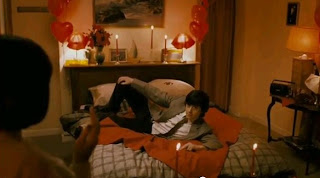
Of course, Richard Ayoade would not write anything and not include humour. We develop an emotional attachment to Oliver. The main part of the humour behind Oliver's character is his social awkwardness, especially with his love life. They both have two different views on love and eachother, but are along the same lines. In the trailer, Oliver's voice over says: "I asked her if she was my girlfriend now, she replied 'I'll think about it' but what she meant was 'Yes, we are now as one'" -Clearly, that would mean 'maybe not' but he's perceived it as something different, hence adding to the amusement. This shows the naivity and vulnerability of Oliver as a character, so we side with him. Our sympathies toward Oliver create an emotional attachment to our main protagonist.
Oliver's attempt at adult behaviour adds extra humour; he blew things way out of proportion making things awkward for the viewer to watch and adds a cheesy element to the romance, showing how inexperienced and awkward he is.
However, there is an element of realism in the story. The difficulty between his parents relationships, his awkward relationship with his parents itself (the lack of connection especially, and the psychological/socialogical doubts they have against him)
The informal first person narrative of Oliver Tate gives a present tense walkthrough the film, the use of the typewriter give an archaic, classic feel to the narration, and even still his life.
Therefore, it gives a saddening approach, that he's behind socially, and technology. That he makes do with what he has, but always aspires for that little bit more.
Submarine is the kind of film that can relate to other films, the story is a familiar story and older audiences can easily relate.
Submarine, an independant film production written by IT Crowd's Richard Ayoade, is written about a 15 year old boy, named Oliver Tate. Oliver Tate is a socially awkward boy, who has two ambitions in life; to lose his virginity, and to keep his parents together. He tries desperately hard to fit in with the other kids in his school. Its more of a story about a growing up romance for adults and late teenagers, who can reflect the awkward and confusing period of time that was school romance.
Oliver Tate isn't your conventional teenager. He's socially awkward, possibility OCD, obsessed with routine and keeping things at an equal level.
The theme to this story is love, which is where the social awkwardness of Oliver plays in. He is young and innocent and in love with a 15 year old girl. However, she is very forward, and very open. She is deviant and has experience.
The first kiss scenes capture the lighter side of the film. The young love allows older audiences to reminisce over their childhood days and remind young audiences of the awkwardness behindthem. These scenes allow the audience to feel like the film will be revolved around Oliver's perception of love; his happiness. The shot captures the emotion and feeling behind the scene, and encases the feel-good vibe which the audience crave so much
Of course, Richard Ayoade would not write anything and not include humour. We develop an emotional attachment to Oliver. The main part of the humour behind Oliver's character is his social awkwardness, especially with his love life. They both have two different views on love and eachother, but are along the same lines. In the trailer, Oliver's voice over says: "I asked her if she was my girlfriend now, she replied 'I'll think about it' but what she meant was 'Yes, we are now as one'" -Clearly, that would mean 'maybe not' but he's perceived it as something different, hence adding to the amusement. This shows the naivity and vulnerability of Oliver as a character, so we side with him. Our sympathies toward Oliver create an emotional attachment to our main protagonist.
Oliver's attempt at adult behaviour adds extra humour; he blew things way out of proportion making things awkward for the viewer to watch and adds a cheesy element to the romance, showing how inexperienced and awkward he is.
However, there is an element of realism in the story. The difficulty between his parents relationships, his awkward relationship with his parents itself (the lack of connection especially, and the psychological/socialogical doubts they have against him)
The informal first person narrative of Oliver Tate gives a present tense walkthrough the film, the use of the typewriter give an archaic, classic feel to the narration, and even still his life.
Therefore, it gives a saddening approach, that he's behind socially, and technology. That he makes do with what he has, but always aspires for that little bit more.
Submarine is the kind of film that can relate to other films, the story is a familiar story and older audiences can easily relate.
The Thriller Tube Map - F'ed's Movie Metro.

The most confusing media tube map created.
It starts with the violence scale, which is the black line across the middle. In the centre we have gangster heavy and gangster light. These variables are significant for the violence scale, and the violence scale only. The lines represent violence, black and white, moral ambiguity, voice over, Brit thrillers, femme fatale and death of main characters. They all intertwine and connect the different film.
Many of the films act as stations, as these films tend to have many of the qualities that the lines represent.
Violence = Black Line
Black and White = Orange Line
Moral Ambiguity = Purple Line
Voice Over = Yellow
Brit Thrillers = Green
Femme Fatale = Pink
Death of Main Characters = Grey
Subscribe to:
Posts (Atom)