Showing posts with label G321 Thriller research. Show all posts

Monday, 17 December 2012

Treatment (Thriller plot line)


We fade into a forest, illuminated by the cold mid-winter dawn.
A man is seen venturing through the woods. The leaves crunch beneath his feet, the snow gathers on his toes.
Twigs snap in the background; he thinks nothing of it.
Seconds pass, and he begins to dwell on the sound.
fearing a presence, he takes a brief look around, as if someone was there.
He reaches down to bury the contents of his pocket, wrapped in a small plastic bag.
In the background, a suited man wearing a venetian Carnivale mask appears, just watching.
He stands up again, looking around, clicking his neck. Unaware of anything else; the venetian masked man in the distance behind him.
he looks around, noticing the man.
He says nothing, and they maintain eye contact.
He promptly starts walking forward to leave the forest.
He looks back as he’s walking, the man closer than before, but standing perfectly still in the same stance, as if he never moved from his original spot.
we cut to a darkly lit scene of him sitting in a room, evidently trapped.
We then return to the forest, the man behind him again.
It begins alternating between him walking through the forest, slowly being caught up, and him locked in the room.
The screen goes black. Silent too;
It cuts to the dark room again, the man is sitting in the corner, clutching his knees, whilst the masked man is staring at him, looming over.
It ends as he looks up to the camera. Turns back to the man, and removes his mask.


The story itself takes it's thriller influence from Dead Man's Shoes - a revenge film involving gang warfare and violent intentions. We borrow the mental ambiguity from a character and give it to our protagonist.
It also takes influence from The Strangers; a cat and mouse style thriller involving murder; the villian in ours slowly catches the protagonist, as happens in both films, in different senses. We also take the scary, impending and unknowing torture element from horror film giant SAW.
Film Noir elements have influenced the writing of the story line, such as the brief emphasis on props, the extreme close angles, the use of suit and mask (mask to represent a hidden emotion or motive) and the limited visibility (interruption and obstruction by trees)
The idea of an enigma is created, as we know nothing about either of them, we have no contextual information behind them or the story.



Tuesday, 11 December 2012

What do directors seek to establish in the opening of thrillers?

What do directors seek to establish in the opening of thrillers?

In the opening of any thriller, or indeed any film, the introduction is vital. No matter what genre or style of film, the introduction has to be good. You can potentially set or build the entire story in just 5 minutes of introduction. You can introduce a character, an event or an entire story. You can set the entire story in motion or say more in the introduction than in the entire story.
Genre has to be established; viewers recognise genre immediately, and can compensate accordingly. If its a horror, the viewer is going to be in a state of anticipation, if an action, the viewer is going to be relaxed and allow the andrenaline of the film to be entice them in its own time.


I am going to use an example.


In Christopher Nolan's The Dark Knight, the second Batman movie in his Batman trilogy, the opening scene is a cloudy sky, that forms the very well known Batman symbol, which fades into black.
From that black scene, a looming audio clip begins, and we appear to be soaring over Gotham City, zooming over to a glass building, where a window promptly breaks; we switch to inside the building to see a clown-masked guy holding a gun which fires zip wire line.
And thus we get brought into Gotham's first crime.
We can already tell that Batman is going to rectify this situation, but we're going to watch this crime unfold first.
The criminals are prepared, equipped with exactly the right tools for their job. They are masked too, adding a sense of anonymity. Currently, we do not know if there is a leader, and we certainly do not know who is who. However, this shot does add a sense of leadership.


This shot is very creepy. It's a lonesome character, holding a mysterious hold-all bag, and eeriely carrying his mask in his left by the side of his body. We can't see his face, he is facing away, giving us his slouching back to us. He looks vulnerable, yet very dangerous still. Presumably, this is the gang leader. (In fact it is the Joker, but we do not know at this point)

The introduction is still vague and unexplained as a blacked out van pulls up, and he gets in. At this point, we still know absolutely nothing other than something big is going to happen soon.
There is always something vague, and shady about a blacked out van.

We still know little, but now the two clowns from the original zip wire line scene have landed on the roof. We are shown their perspective of Gotham, a New York-esque city, where no one is taking any notice of them. We encounter the other clowns that picked up our main clown, and we are finally given some incite to their plans.

"Alright, lets do this"
"Just three guys?"
"Two guys on the rope. Each guy gets a share, 5 shares is plenty"
"6 shares, don't forget the guy who planned the job"
"yeah, he thinks he can sit it out and still take a slice, then I get why they call him joker"

We've established that we're now heading to a crime. we switch between the two and the three clowns. The two clowns are switching off the power, and the three are taking the front doors.

We now learn more about our location, and our genre in three brief seconds of the film.
The clowns storm into a bank, and are clearly about to perform a robbery.
Bank robbery - classic crime film etiquette.
Violence and gunfire ensues.

However, there's a twist.
One of the clowns kills the other one.

A sense of mystery has just been added, normally accomplices do not kill each other off.

Not only is a robbery taking place, but something is happening between them. A twist; a clever sense of mystery established in a very full on opening scene. Who are these people? what are they doing? What is the significance of the masks? Christopher Nolan has already established a guessing game within 2 and a half minutes of his film.

The other clowns are now taking hostages; classic crime/action etiquette again, however there is a more destructive twist, as instead of just binding their hands, they are bound and given grenades.


A usual action film prop would be a hand gun, however we're witnessing a grenade. A weapon capable of great destruction, and the audience sense an element of danger. We also witness the other clown pulling the pin, followed by the line "obviously, we don't want you doing anything with your hands other than holding on for dear life"


The bank manager is fighting back, having taken out Chuckles, the other two clowns (Bozzo and Grumpy) jump for cover. Everybody likes a shootout, however this one does. However, it's short as Bozzo fires back promptly.

We go back to the actual bank vault, where we find out it's a mob bank
(relates back to bank managers line "do you have any idea who you're stealing from?!")
Happy (Vault clown) had been struck with 5,000 volts previously, so we know whatever is happening, is going to have huge consquences.


Yet again, another clown is being killed off. Grumpy is killing off Happy, which confuses the whole robbery even more, bringing the numbers down surely increases the shares, but how does it help them other than that? why are they being killed off?

We then have a showdown between Bozzo, and Grumpy, who appear to have been friendly and working together. They collect the money, and then Grumpy pulls a gun on him. The power is centralised in Grumpy, who is holding the gun, therefore the audience side with him. It's a confusing moment, but Bozzo plays it cool. (we can instantly hear Heath Ledger's Joker voice when Bozzo talks, but that information is irrelevant at this point)
The dialogue goes as follows.

"i'm better the Joker told you to kill me as soon as we loaded the cash?"
"no, no. I kill the bus driver"

Then Grumpy says exactly what the viewer is thinking.
"What bus driver?"

Completely out of nowhere, this occurs.

The driver jumps out, and packs the money in the car.
The audience is finally in the knowing; this characer is getting killed.
Sure enough, Bozzo shoots him.

He then makes his way over to the last bag, when the bank manager crawls up, and talks to him.
He's arguing with him about his motives, when Bozzo approaches him.

"I believe, what doesn't kill you.. simply makes you. *removing mask* stranger"

And here we introduce our main villain: The Joker.
He was not introduced as our main villain at all; he introduces himself at a point in the film where it could almost have been accidental. He was not going to remove the mask.
The other clowns joke about him, laughing at his make up and about his plans, and he remains quiet.

Christopher Nolan built up the introduction perfectly. He introduced his film perfectly; he explained nothing. He started with an organised display of crime, that built up the insanity of his main character perfectly. Nothing is explained, using inference we learn absolutely everything.
The genre is placed very quickly between crime and action, the thriller element constantly there.
The character is perfectly portrayed without saying much at all.
Plot isn't even covered, we know nothing of the plot and what's going to happen, we just know that Batman is in this film, and evidently now, so is the Joker.

Tuesday, 27 November 2012

The Thriller Tube Map - F'ed's Movie Metro.


The most confusing media tube map created.

It starts with the violence scale, which is the black line across the middle. In the centre we have gangster heavy and gangster light. These variables are significant for the violence scale, and the violence scale only. The lines represent violence, black and white, moral ambiguity, voice over, Brit thrillers, femme fatale and death of main characters. They all intertwine and connect the different film.
Many of the films act as stations, as these films tend to have many of the qualities that the lines represent.

Violence = Black Line
Black and White = Orange Line
Moral Ambiguity = Purple Line
Voice Over = Yellow
Brit Thrillers = Green
Femme Fatale = Pink
Death of Main Characters = Grey

Wednesday, 14 November 2012

Harry Lime

How is the sense of Claustrophobia and Doom explored in The Third Man

 The Third Man is a Pulp film (crime fiction magazine) featuring the story of Harry Lime in a post war Vienna. It's produced and based in 1949, in a prime example of Film Noir's World War influence. Vienna is perfectly portrayed in the Film Noir style, some what destroyed, badly lit (very dark) and the air of depression ever present.

The Plot features Holly Martins travelling through Vienna, where he ends up investigating the peculiar death of his old friend, one Harry Lime, who was involved in illegal black maket trading.

Film Noir is always about the atmosphere created in the shot. It goes hand in hand with tension, drama and dialogue, enhancing the viewer experience. One way to create the vague and eerie atmosphere is by making a sense of claustrophobia in the shot.

This is acheived through the long scene in The Third Man, which is a sewer chase scene. It is the epitome of the film, Harry Lime has been discovered and Austrian police and soldiers are chasing him through the many tunnels.


In this shot, the sense of claustrophobia is ever present; the perspective we get from the long shot is that we're in the tunnel with him, far deeper though. The sense of depth is created by the camera being so far away from the source of light, which is at the end of the tunnel (Light at the tunnel idea)
The tunnel is very narrow and poorly lit. The light reflects off the trail of liquid down the middle giving a sense of how dirty the tunnel. We can see there is only one way out, and several paths going off, giving the idea that Harry Lime is going to be trapped. He's merely a silhouette at the end of the tunnel, insinuating that his identity is vague and darkened. The tunnel idea feels like its slowly enclosing in on him - perhaps a metaphor that he's running out of luck?


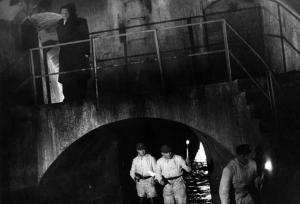
Another close sewer scene is the shot above. It's slightly tilted, and gives it a very disorientated feel. We get the sense that we are also hiding with Harry, and evading the authorities that are chasing, we feel subtle and obscured, which works to build the tension in the scene. We can see here that Harry is just above them, hinting that he's the higher character in the scene. We can clearly see that he is pressed against the wall, hiding, terrified; clear representation of good and evil. The police are the good side here, looking to arrest their offender and the evil side is Harry Lime - a doctor (man of valued profession) who did not deserve such a career for his illigetimate trading of counterfit medicines. He is dressed in the colours of the shadows - black to represent the darkness of his actions, the evil - Police are dressed in white to be the purer side of things.
This is classic Film Noir. Moods represented through lighting, clothing, and position of characters.
It's a very claustrophobic scene, showing us that Harry Lime is in danger of being caught - how close they are to him, one move around and they would see him.


This shot is iconic in the scene. It perfectly shows the mood of the scene from Harry Lime's perspective. The lighting upon the upper side of his face is representative of the regular Film Noir moral superiority or ambiguity. The bottom half is much darker, showing the contrast between him and the above. It shows that he doesn't share such a properties as he is the bad side. The light could suggest 'good' and what he could have been. There is a clear expression of panic on his face showing that he's finally acknowledged the impending doom that he will undoubtedly encounter. It could also insinuate that he is a morally confused character, that he has seen the error of his ways but cannot undo or justify them now.  He is sweating, he is clearly worried about the outcome from this section of the film. We don't know any of what's occuring outside the shot or around him, we are focused soully on him.


This is the moment we know Harry's fate is sealed. He is trapped, the grate is firmly shut and cannot be opened. He is stuck underneath, in the stairwell, simply waiting. He can feel the wind on his fingers, the sense of freedom just beyond his reach. It can be viewed he is reaching up, almost looking for repentance or forgiveness. Harry's fate is clearly sealed here, as this is the last way out.

Sunday, 11 November 2012


How does Casino Royale use conventions of film noir, and what meanings/connotations are created?


Casino Royale starts with a completely different introduction. It's separate from the rest of the film, in the way that it is shot in black and white, hinting at a Film Noir influence. 

This shot is an extreme long shot, and fully displays the building in which the intro is going to take place. As is typical in a film noir shot, it's shot from a low angle, displaying a wide view of the building/landscape, adding a sense of anticipation.


We can see a source of light in the shot, as is typical. The light is presented through the lone lamp post in the middle ground. Its almost as if the entire shot is illuminated from that point. Lamp posts were frequently used in Film Noir. The lamp post acts as both a location, under which a character would stand and a single source of light for the clip. 


Here, we're introduced to our bad guy. We can tell he's the villain due to the nature of his introduction. He gets out of a classy car in the darkness of night and the camera shoots him from a low angle, so that we look up at him. In this midshot, we can see his face has a sinister, but worried expression on it. This would evidently mean that he anticipates some kind of confrontation, or that something is going to occur in the next scenes. 


Props. In film noir, props are often fairly limited, normally revolving around cigarettes, guns, torches etc. In the drawer of his desk, we notice a pistol. The pistol is an icon of film noir, frequent shoot outs and murders meant that they were often on show. So naturally it was only a matter of time until a weapon was released into the scene. Therefore, we get a sense of tradition and that Casino Royale - a James Bond (crime/hero/action film) is looking back at the Film Noir era with a sense of respect.


A traditional Film Noir setting - The office. We have a wide shot of both characters here. It appears that the villain in the scene is in the well lit section of the room, on the right, and our protagonist, James Bond is sitting in the shadows of the left side, his face only partially lit. This adds a sense of gloom to the scene; the villain has the power in this shot, whilst Bond, only somewhat visible is made to seem like he's in danger. 


This scene is the darker side of Noir; the violence. Seeing as James Bond is more of an action film, the action is of course exaggerated. Film Noir violence tended to be intense eye contact, followed by a single bullet to the upper torso whilst the camera followed the character to the floor.
This scene is very bright when it comes to lighting. The white tiled walls of the bathroom they're fighting in give a sense of openness, and almost finality. We can tell that it's going to be a fight till the death. The contrast is developed through Bond's black suit jacket; this makes him look like the superior force here, as he stands out in the scene. 

Here is the scene in it's entirety.


Monday, 5 November 2012

Character Archetypes of Film Noir

Conventions of Film Noir (part 3)

Character Archetypes - Characters in Film Noir

Noir (anti) hero

The male protagonist in a Noir film will always be either a hero, or an anti hero. Anti hero obviously being a villain of some sorts.
A hero can be anyone. Usually, it's along the lines of a police officer (cop in this case), a strong witted, hardened detective or another sort of private eye.
The anti hero is usually a criminal master mind or along those lines; mafia members, murderer etc.
It often transpired that the Noir hero wouldn't have the happy ending.
They were frequently stricken somehow, be it with a mental inability, like depression, a physical affliction, like a limp or an addiction, like alcoholism. Maybe they'd suffered some event like a divorce or similar. Regardless, it was not usually a happy story.


A perfect example of a hard boiled Noir detective - Sam Spade from The Maltese Falcon.

Femme Fatales

Female characters came in the form of two types of women.
The first form could be a love interest. A powerless and gentle victim, symbolic of pure emotion. Simply, a woman that the male protagonist develops feelings for.
However, often enough the character in question is what is considered a 'Femme Fatale' literally, fatal female. These characters were more alluring towards the male protagonist, using beauty or persuasive words to convince the 'Noir Hero' down a dark road of (often) self destruction, with the promise of love or affection. This may be through enticing them to murder or commit other crimes.


Kathie Moffat, female character from Noir film Out of The Past. A perfect example of a femme fatale!

Camera Work in Film Noir

Conventions of Film Noir (pt 2)
Film Noir is used throughout the thriller genre. It's a much older style of film and it's a wide

Camera work.

Camera work is essential in all film. Especially in Film Noir, camera angles, distances and shot type.
For example, in this shot, we're experiencing an extreme angle. The angle has been used to show the scene from the end of the gun, so we experience what the character experiences. This helps us place ourselves in the same position and feel the same emotion as a viewer.


Of course, as with all films, the same variety of shots exist. 


ECU - Extreme Close Up. Closer than a regular close up, takes up most of the screen. normally just one detail, like the gun in the shot above.
CU - Close Up. Camera is close to us, normally portraying a face and an expression.
MCU - Medium Close Up. Character is shown from chest up.
MS - Medium Shot/Mid Shot. Generally from waist up, displaying background aswell.
MLS - Medium Long Shot. Used in Film Noir, people are shot from the knees up. Shows any kind of action as a full.
LS - Long Shot. Whole camera is at a distance from what it's filming. This means characters are shot from head to toe, and/or background is fully captured

ELS - Extreme Long Shot. Camera is far away, showing as a wide and broad image of the scene. Maybe used to emphasis background, setting, emotion or just a lot of action.


A very stereotypical long shot of Manhattan showing two characters as a silhouette, and a well lit background gives the sense of setting and space.

Tuesday, 23 October 2012

Setting and Costume in Film Noir.

Conventions of Film Noir (part 1)

Setting and Costume in Film Noir


Film Noir is renouned for the classy, silhouette style. The whole style consists of contrasts between the costume and the setting, which is heavily aided by the lighting.
The fims focus on either detectives, gangsters or generally other organised criminal activity, so the dress code is normally a black, grey, brown or pinstripe three piece suit, accompanied by a fedora of a similar colour.
Normally, a cigarette or cigar would be present; the smoke seems to contribute effectively to the contrast of the entire image.


Not from a film, but this picture of Al Capone sums up everything the Film Noir era embodied in film. The films imitate the real life image of the gangster/cop 40s conflicts. The style refers to the classy suit style of the '40s; grey, pinstripe or black suits. The fedora hats and cigars/cigarettes. The image of the characters is the biggest part of the visual experience, as the dark clothing of the protagonists or characters in the lighting of film noir creates great black shadows behind, complete silhouetting of the character, or the overly illuminated foreground effect. 


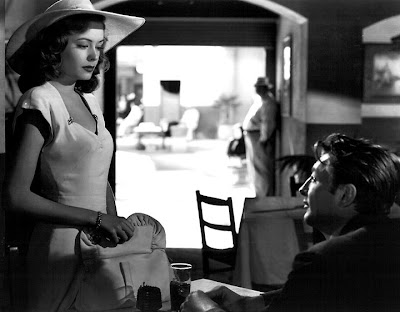
The women wore very glamorous 1940s dresses. The theme of class was always present, which is normally expressed through the medium of clothing. The reality is, the dresses would be in deep reds, blues or purples, but due to the greyscale/black and white filming of the Noir era, they always come out as grey, giving an extra sense of sophistication. Yet again, cigarettes were often present.


Generally, Film Noir settings seem to be in prohibition period cities; Chicago, Los Angeles, San Francisco, and New York. However, they could take place in small towns, suburban settings, rural areas or the open road. The buildings they take place in tended to be bars, lounges, nightclus, gambling dens, houses, stairways, offices, jails or bedrooms. The typical ending took place in visually complex, often industrial settings, such as refineries, factories, trainyards and power plants.


One Film Noir film we looked at was Double Indemnity.
In the "I killed him" scene at the start, traditional setting and costume is summarised. Walter Neff (portrayed by Fred MacMurray) is sitting in an office, smoking a cigarette. He is in a suit and a fedora hat, as is the style.
Also adding to the Film Noir setting is the fact that he's discussing a murder; another crime film. The shadows in the background are heavy, and Walter is very well lit, setting the mood for the scene, putting all the focus on him.


Sunday, 23 September 2012

Intro!

Hi there!
I'm Felix, and this is my media blog.

Consider this the first post!

It shall contain my AS media work, and any pictures, videos, quotes or what ever else I find appealing or amusing.

like this scene from Spartacus.


-Felix.